Showing posts with label CMMD. Show all posts

Sunday, June 2, 2013

Navotas Marine Tree Park


Some 10 kilometers north of Manila stands Navotas City, an urban sprawl long-known for its shipyards, fish-preparation plants, and fishponds.  But thanks to the successful implementation of the National Greening Program (NGP) in the area, Navotas may yet again become famous for quite another remarkable development: the first locally established Marine Tree Park in the National Capital Region. 

This long, rickety bamboo bridge serves as the main access to the Navotas Marine Tree Park
Created in 2011 thru Barangay Ordinance No. 4 of the Barangay Council of Tanza, Navotas City, the Marine Tree Park is a testament to the strategic importance of involving the local government in the conservation and ecological rehabilitation efforts of the Department as now, the Barangay Council is active more than ever in the greening program, as well as in other related activities.

Barangay Chairman Carlito M. De Guzman (in yellow shirt) of Tanza, Navotas is flanked by volunteers from the University of the Philippines-Manila 
Initially, in 2010, the DENR-NCR office, thru the Coastal and Marine Management Division (CCMD) of the Protected Areas, Wildlife and Coastal Zone Management Service (PAWCZM), recommended the 29.47 hectare coastal land in Barangay Tanza as one of the major mangrove enrichment planting sites in NCR under the NGP, home as it is to the only remaining old and naturally growing mangrove stands in Manila Bay—a reminder of its once teeming marine and avian ecosystem.

Young mangrove trees along the stream banks of Navotas Marine Tree Park 
To harness and maximize this interest, DENR-NCR conducted a series of information and education campaign about the ecological functions of mangroves and its potential economic contribution to the residents of the area.   These were done firstly, among the local barangay officials and later, at the community or grassroots level. 

A stronger bond and understanding between DENR-NCR officers and the local community resulted in these endeavors, culminating with the passage of the ordinance declaring the area as a protected marine tree park.

In the two years that has passed since its establishment, the CMMD was able to plant 20 hectares of mangroves.  This year, it aims to add another 10 hectares.

Mangrove nursery
The importance of mangroves to Navotas City cannot be understated.  Lying below sea level, mangroves help mitigate the impact of typhoons on the coastal city, says CMMD Chief Teresa Salanguit.  Mangroves act as a natural buffer against waves that surge towards the city during the onslaught of typhoons which, as a result of climate change, becomes more frequent and stronger.

"Dense mangroves provide good protection against sea surges," she added.

Aside from protecting the coastal barangays of Navotas from environmental shocks and stresses, mangroves play an important ecological function.  Mangroves serve as food, nesting and nursery grounds for various high-value aquatic resources.  It also helps in filtering water by absorbing pollutants.  More importantly, mangroves act as a carbon sink, absorbing and trapping greenhouse gases.

The CMMD plans to repopulate the area with bungalon mangrove trees.  The 'bungalon' is a mangrove specie that is sturdy enough to withstand sea surges.  Bungalon trees once dominated Navotas' mangrove area but infestation by the aroma beetle in the 1990s reduced its population.

Apart from extending the coverage of the mangroves in the area, PAWCZMS Regional Technical Director Donna Mayor-Gordove says that the agency plans to undertake streambank stabilization in the area.  Other mangrove-related and beach type trees like the 'talisay' and coconuts will be planted along riverbanks in the mangrove area to stabilize conditions.
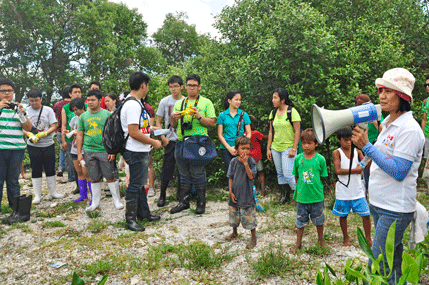
Likewise, the agency is promoting more clean-up activities in the mangrove area.  Gordove said that clean-up activities must be sustained because tidal flows bring to the area assorted garbage such as plastic products, slippers and other items that are dumped into the Manila Bay.

CMMD Chief Teresa Salanguit briefs volunteers during a coastal clean-up and mangrove planting activity in the area

Volunteers from UP-Manila College of Medicine planting mangroves

During one such activity for example, Gordove reports that volunteers were able to recover some 500 sacks of garbage in less than 3 hours. 

This makes, she concludes, the continuous coordination with Navotas City officials, private organizations and other agencies regarding cleaning up the area very critical.

Parties interested in doing volunteer work for the mangrove rehabilitation program in Navotas Marine Tree Park can contact DENR-NCR at (02) 435-25-09 for details.

A pair of Little Egrets scouring for food along the beach.  The Navotas Marine Tree Park also attracts a number of migratory bird species

Sunday, May 19, 2013

About PAWCZMS

PROTECTED AREAS, WILDLIFE AND COASTAL ZONE MANAGEMENT SERVICE (PAWCZMS)

The Protected Areas, Wildlife and Coastal Zone Management Service (PAWCZMS) of the Department of Environment and Natural Resources-National Capital Region (DENR-NCR) is primarily in charge with the preparation of action programs and implementation strategies on conservation and protection of wildlife, coastal and marine resources of the region. It has two divisions and one special unit under it. These are Protected Areas and Wildlife Division (PAWD); Coastal and Marine Management Division (CMMD); and the Las Piñas-Parañaque Critical Habitat and Ecotourism Area (LPPCHEA).

PROTECTED AREAS AND WILDLIFE DIVISION (PAWD)

PAWD was created pursuant to DAO 1992-25 (Section 36) which provides for the creation of a PAWD in each region where protected areas have been established.

The Division coordinates and monitors activities related to protected area management, wildlife resources conservation and law enforcement within the region.

Under the wildlife conservation efforts, the PAWD is the one primarily in charge in the regulation of wildlife trading, breeding and possession. They process the issuance of the following permits following the procedures and requirements provided for in Republic Act 9147 (Wildlife Resources Conservation and Protection Act):

  1. Certificate of Wildlife Registration (CWR); 
  2. Wildlife Farm Permit (WFP); 
  3. Wildlife Import/Export Certificate (WIC/WEC); 
  4. Local Transport Permit (LTP); 
  5. Wildlife Special Use Permit (WSUP). 
Another work of the PAWD in relation to wildlife conservation and protection is ensuring the strict implementation of existing laws, rules and regulations on wildlife (law enforcement). This is done through the conduct of surveillance and operations tracking illegal trading of wildlife and prosecuting its perpetuators, in partnership with other law enforcement agencies and deputized Wildlife Enforcement Officers (WEOs).

The Wildlife Traffic Monitoring Units (WTMU) required created in strategic air and seaports pursuant to Republic Act 9147 is being supervised by this Division. The primary function of the WTMUs is to ensure the strict compliance and effective implementation of all existing wildlife laws, rules and regulations, including pertinent international agreements.

COASTAL AND MARINE MANAGEMENT DIVISION (CMMD)

The CMMD was established through DAO 2002-08 which provides for its creation in regions where there exist coastal areas. Its tasks, among others, are:

  1. Prepares action programs and implementation strategies on coastal and marine environment; 
  2. Provides technical assistance to LGUs, NGOs, and PO in the Region; 
  3. Coordinates with the LGUs and other concerned sectors and agencies in the creation of task forces on coastal and marine environment; and 
  4. Conducts information, education and communication activities, as well as capability-building on coastal and marine management concepts, tools and technologies. 
The aforecited tasks are carried out by the CMMD through the implementation of programs and projects involving (1) habitat and resources restoration, (2) provision of technical assistance to LGUs, NGOs and POs in the conduct of training, workshops, seminars pertaining to integrated coastal resource management, (3) spearheading of environmental events and celebrations focusing on coastal and marine such as the celebration of Month of the Ocean, World Water Day and International Coastal Cleanup to promote awareness, and (4) formation and operationalization of Coastal Law Enforcement Alliance in the NCR (CLEAR-NCR). 

The CLEAR-NCR was established to have a more coordinated manner of coastal law enforcement and environmental campaign in Manila Bay. It is composed of of 5 coastal LGUs, 7 NGAs (PPA, PCG, MARINA, PNP-Maritime, BFAR, LLDA, EMB), 2 NGOs (101st PCGA & Manila Yatch Club) 3 POs (City FARMCs of Navotas, Las Pinas and Paranaque).

The overarching thrust of CMMD in undertaking these programs and projects is making coastal communities resilient to climate change effects. Studies on climate change show that coastal communities are predicted to bear the brunt of the climate change effects. Habitat restoration efforts, capacity-building for LGUs and the people to undertake an integrated coastal resource management approach, and raising their awareness on various coastal and marine management issues would help them mitigate and adapt to climate change effects.

Reforestation of existing mangrove areas and restoring mangrove forests would not only help reduce green house gases from the atmosphere. It also forms natural barriers which provide shore protection both under normal sea conditions and during typhoons. Because of their intricately entangled above-ground root systems, mangroves protect shorelines during storms and typhoons by absorbing wave energy and reducing the velocity of water passing through the root barrier. Mangroves also facilitate soil accretion thus stabilizing the coastline by catching sediment washed downstream.

LAS PIÑAS-PARAÑAQUE CRITICAL HABITAT AND ECOTOURISM AREA (LPPCHEA)

a. Legal Bases
The Las Piñas-Parañaque Critical Habitat and Ecotourism Area (LPPCHEA) was established by virtue of Presidential Proclamation No. 1412 dated April 22, 2007, which was amended on January 31, 2008 by Presidential Proclamation 1412-A.

P.P. 1412-A directs all relevant departments and instrumentalities under the executive branch to ensure the preservation of existing mangrove, mudflats and ecosystems in the area that supports natural ecological functions. It also directs the DENR to convene and chair a Manila Bay Critical Habitat Management Council.

b. Rationale for its Declaration as a Critical Habitat

Its declaration as a critical habitat was based on the findings that it hosts at least 5,000 heads of diverse species of birds both migratory and residents. Most significant is the presence in the area of at least 1% of the population of Greenshank and 10% of the population of Black-winged Stilt within the East Asian-Australasian Flyway.

Moreover, its proclamation is consistent with and in support of Philippine commitments to international conventions, such as:

  1. Convention on Migratory Species (CMS,1994); 
  2. Convention on Biological Diversity (CBD,1992); 
  3. Convention on International Trade in Endangered Species of Wild Fauna and Flora (CITES); 
  4. International Convention on the Conservation of Wetlands (RAMSAR Convention). 
c. Location and Significance of the AreaThe LPPCHEA is located on the western side of the Aguinaldo Highway (Coastal Road) and is bounded on the north by the Paraňaque River and on the South by the Las Piňas River. It covers an area of 175 hectares consisting of mangroves, mudflats and diverse avifauna. It is the first critical habitat established in the country. 

The LPPCHEA is said to be “the last coastal frontier of Metro Manila”. It is the only coastal ecosystem along Manila Bay with high diversity of plants and birds. For this, it has become a showcase for students, researchers and nature lovers.
Manila Bay is one of the most important coastal wetlands hosting more waterbirds than any other areas in the Philippines. With its degradation, birdcounts also decline which can be attributed to the loss of habitats - mangrove areas were converted into fishponds while others are converted into commercial, industrial and residential areas.

d. Wildlife and Natural Resources Found in the Area

Birds
LPPCHEA harbors more than 5,000 heads of birds at one time. To date 80 species of birds has been recorded in the area, around 50% of which are migratory. Rare species such as Pied Avocet and Grey-tailed Tattler invited attention of birders to the area. The sightings of the Siberian Rubythroat triggered interests among bird enthusiasts both foreign and local.

The area is also known for the Philippine Duck, an endemic and vulnerable species. Hundreds of them could be observed during migration season when they mingle with migratory species. Another species worthy in the area is the endangered Chinese Egret.

Mangroves
Another important element of the LPPCHEA is the mangrove forest – the thickest stands among the mangrove areas within Manila Bay covering 30 hectares. There are 8 species of mangroves in the area, namely: bungalon, bakauan babae, pototan, kulasi, pagatpat, bangkau, banalo and buta-buta.

Mangroves serve as roosting areas for birds, provide spawning grounds for marine life, serve as natural barriers to storm surges and filter pollutants from water.


Mudflats
Taken for granted are the mudflats which people thought only as “burak” and useless. LPPCHEA has 114 hectares of mudflats which serve as feeding grounds for the birds. As the water recedes during low tide, it exposes small invertebrates that serve as food for the birds. Thus, many birds could be observed during low tides in the early morning and late afternoon.


: